

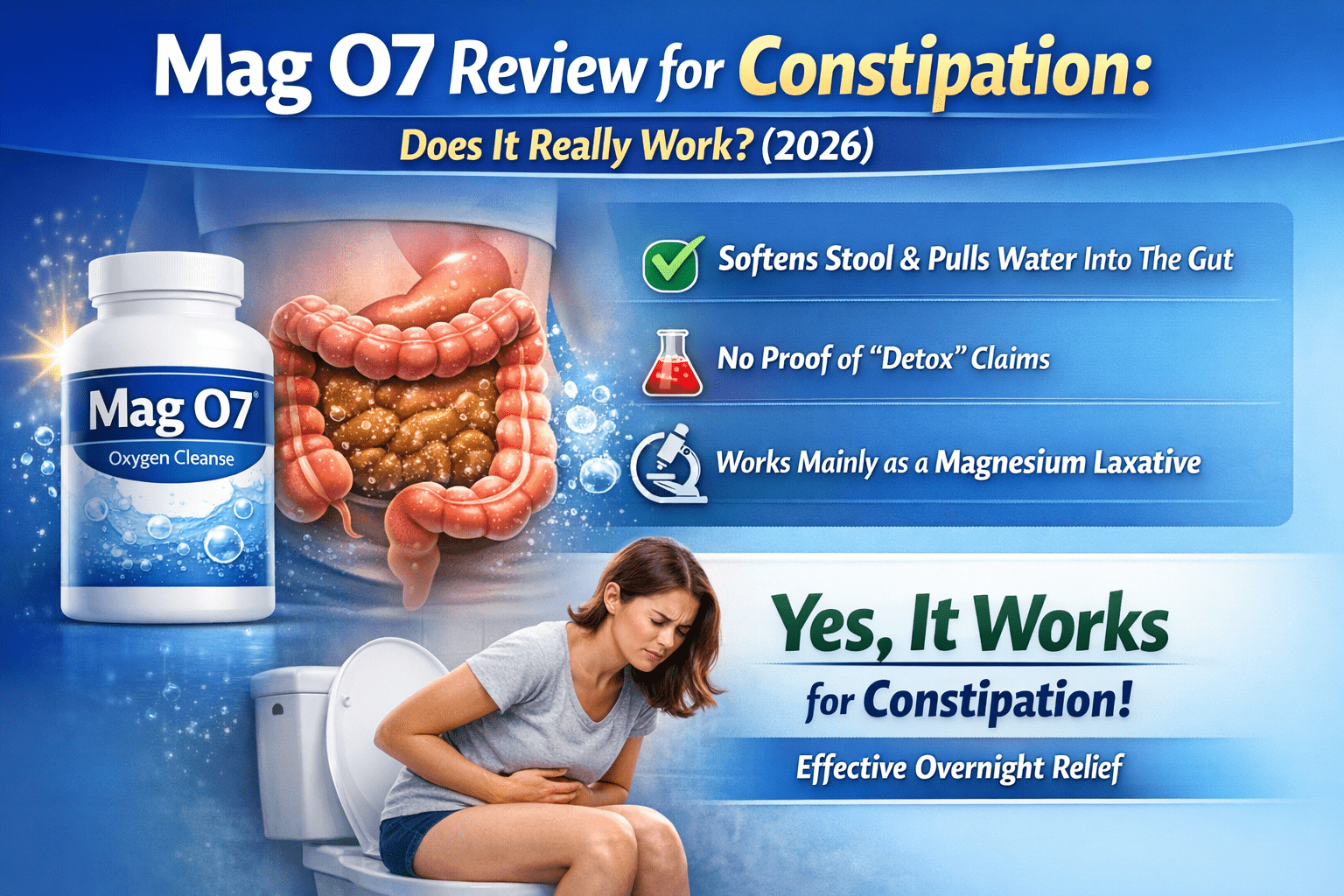
Mag O7 review for constipation is one of the most searched supplement topics among people who are tired of harsh laxatives and want a gentler, more natural solution. If you have been dealing with chronic constipation, bloating, or irregular bowel movements and have come across Mag O7 — also written as MagO7 — you are probably wondering whether this ozonated magnesium supplement actually delivers what it promises.
In this comprehensive, research-backed Mag O7 review for constipation, we break down exactly what this supplement contains, how it works inside the gut, what clinical studies say about magnesium oxide as a laxative, who it is best suited for, what the real side effects are, and whether it is worth buying in 2026. We also compare it to alternative options and tell you precisely what to expect when you use it.
By the end of this guide, you will have everything you need to make a fully informed decision.
What Is Mag O7?
Mag O7 — originally manufactured by Aerobic Life and now produced by nbpure (formerly Nutritional Brands) — is an ozonated magnesium oxide supplement that has been on the market for over 25 years. It is marketed primarily as an oxygen-based colon cleanser and natural laxative alternative designed to relieve constipation without cramping, without harsh stimulant laxatives, and without dependency.
The supplement is available in two forms: capsules (30, 90, and 180 count) and powder. The capsule version is more popular and widely available through Amazon, GNC, Vitamin Shoppe, and health food stores across the United States.
Despite being around for over two decades, Mag O7 has seen a significant surge in popularity in recent years — particularly among people on GLP-1 medications such as Ozempic and Wegovy, which are well-known to cause constipation as a side effect. Thousands of Amazon reviews rate it highly, and it is frequently recommended in gut health communities and forums.
But does the science actually back it up? Let us find out.
Mag O7 Ingredients: What Is Actually Inside?
Understanding what Mag O7 contains is the first step to evaluating whether it can genuinely help with constipation.
Active Ingredients (Per 3-Capsule Serving)
| Ingredient | Amount | % Daily Value |
|---|---|---|
| Magnesium (as Ozonated Magnesium Oxides — MOXiO3™) | 1,035 mg | 246% |
| Potassium (as Potassium Citrate) | 99 mg | 2% |
Other Ingredients
- Certified Organic Rice Flour
- Citric Acid
- Vegetable Cellulose Capsules (vegan-friendly)
What Makes It “Ozonated”?
The term ozonated magnesium oxide refers to magnesium oxide that has been treated with ozone gas during manufacturing. According to the manufacturer, this process causes the magnesium oxide to become unstable in an acidic environment — meaning that when it reaches the stomach acid, it begins releasing reactive oxygen species (ROS) slowly over a period of 12 or more hours.
The magnesium acts as a carrier vehicle to transport oxygen through the intestinal tract. As the oxygen is released throughout the digestive system, it is claimed to soften hardened stool build-up, bring water into the bowel, and gently stimulate bowel movements without the cramps associated with stimulant laxatives like senna or bisacodyl.
The potassium citrate in the formula acts as an acidity regulator that helps stabilize the oxygen release mechanism.
It is important to note that Mag O7 is not intended to be a magnesium supplement in the traditional sense. Because ozonated magnesium oxide is less bioavailable than other forms of magnesium such as magnesium citrate or magnesium glycinate, this product is specifically designed for gut cleansing and laxative purposes — not for addressing magnesium deficiency.
How Does Mag O7 Work for Constipation?
To understand how Mag O7 works, you need to understand the underlying mechanism of magnesium oxide as an osmotic laxative — and then consider the additional ozonation component.
The Magnesium Oxide Mechanism
When magnesium oxide enters the stomach, it reacts with stomach acid (hydrochloric acid) and is converted into magnesium chloride (MgCl₂). This then moves into the small intestine, where it is converted by pancreatic secretions into magnesium bicarbonate and eventually magnesium carbonate.
These magnesium compounds significantly increase the osmotic pressure inside the intestinal lumen. In simple terms, they draw water from surrounding tissues into the bowel. This increase in water content softens the stool, increases stool volume, and stimulates the intestinal walls to contract — triggering the muscle movements (peristalsis) that push stool toward the rectum.
This mechanism is similar to how magnesium citrate works, which is why both are classified as osmotic laxatives — they work by drawing water into the gut rather than chemically stimulating the bowel like senna does.
The Ozonation Component
The ozonated aspect of Mag O7 adds a secondary mechanism. As the product manufacturer explains, the slow release of reactive oxygen species throughout the digestive tract is intended to:
- Help break down hardened, compacted stool that has adhered to the colon walls
- Gently oxidize waste material to make it easier to pass
- Support a cleaner colon environment without disturbing the gut microbiome in the way that harsh chemical laxatives do
It is worth noting that while the osmotic laxative mechanism of magnesium oxide is extensively documented in clinical research, the specific ozonation component has less independent peer-reviewed evidence supporting its unique contribution. Most of the clinical evidence supporting Mag O7’s efficacy applies to magnesium oxide broadly rather than specifically to ozonated magnesium oxide.
For a broader understanding of how different types of laxatives work, see our guide on Best OTC Laxatives for Constipation in the US.
What Does the Clinical Research Say?
This is where this Mag O7 review for constipation gets genuinely interesting — because the scientific evidence supporting magnesium oxide for constipation is actually quite strong.
Study 1: Randomized Double-Blind Placebo-Controlled Trial (Mori et al., 2019)
One of the most important clinical trials on magnesium oxide for constipation was a randomized, double-blind, placebo-controlled study published in the Journal of Neurogastroenterology and Motility. Researchers enrolled 34 female patients with mild to moderate chronic constipation and randomly assigned them to receive either magnesium oxide (0.5g × 3 times per day) or a placebo for 28 consecutive days.
The results were striking. The response rate for overall symptom improvement was 70.6% in the magnesium oxide group, compared to just 25.0% in the placebo group — a statistically significant difference. Patients receiving magnesium oxide also showed improvements in spontaneous bowel movement frequency, stool form on the Bristol Stool Scale, colonic transit time, abdominal symptoms, and overall quality of life.
Study 2: Senna vs Magnesium Oxide Randomized Trial (Tomita et al., 2021)
A landmark three-arm randomized, placebo-controlled trial published in The American Journal of Gastroenterology compared the efficacy of senna (a stimulant laxative), magnesium oxide (an osmotic laxative), and placebo in 90 patients with chronic idiopathic constipation. Patients were treated for 28 days.
The response rates were: placebo 11.7%, senna 69.2%, and magnesium oxide 68.3% — both active treatments were virtually equally effective. Crucially, senna use was associated with more side effects including stomach discomfort, nausea, and cramping, whereas magnesium oxide was significantly better tolerated. This is directly relevant to Mag O7, as it suggests the magnesium oxide base is both effective and gentler than stimulant alternatives.
Study 3: American College of Gastroenterology Guidelines (2022)
In a landmark joint clinical practice guideline issued by both the American College of Gastroenterology (ACG) and the American Gastroenterological Association (AGA) — the first joint guideline ever developed by both organizations together — magnesium oxide was recommended as one of the evidence-based treatment options for chronic idiopathic constipation (CIC) in adults. This was a significant endorsement from the highest level of US gastroenterological authority.
Study 4: Magnesium Oxide vs Probiotics in Children (Kubota et al., 2020)
A double-blind, randomized clinical trial published in the journal Nutrients found that magnesium oxide was as effective as Lactobacillus reuteri DSM 17938 (a well-studied probiotic strain) for managing functional chronic constipation in children. While the probiotic had additional microbiome benefits, magnesium oxide produced equivalent improvements in bowel movement frequency and consistency — suggesting it is appropriate for both children and adults when used carefully.
Study 5: PMC Comprehensive Review (Mori, Tack & Suzuki, 2021)
A comprehensive review of the clinical evidence for magnesium oxide in constipation, published in the journal Nutrients (PMC), concluded that while magnesium oxide has been widely used as a laxative for decades based primarily on empirical knowledge, two recent randomized controlled trials have now confirmed its safety and efficacy for treating chronic constipation in adults. The review identified key safety considerations including the risk of hypermagnesemia (elevated blood magnesium levels) in patients with kidney disease or at high doses — something we cover in the side effects section below.
For more on fiber-based and supplement-based approaches to constipation, read our evidence-based guide on 7 Natural Fiber Supplements for Chronic Constipation.
Mag O7 Review: Key Benefits for Constipation
Based on the clinical evidence and consistent user reports, here are the main benefits that make Mag O7 a credible option for constipation relief:
1. Overnight Relief Without Cramping
This is the most widely reported benefit. Unlike stimulant laxatives such as senna or bisacodyl, which forcefully contract the colon muscles and often cause painful cramping, Mag O7 works through an osmotic mechanism — drawing water into the bowel gently and gradually. Most users report a comfortable, urge-free bowel movement the following morning when taken at bedtime.
2. Non-Habit Forming
One of the most important concerns about laxative use is dependency. Stimulant laxatives are associated with the colon becoming reliant on chemical stimulation over time, which can worsen chronic constipation in the long run. Magnesium oxide does not trigger this dependency cycle. The American Gastroenterological Association’s guidelines support its use for chronic constipation partly because it does not cause tolerance with continued use.
3. Clinically Validated Efficacy
As detailed in the research section above, magnesium oxide — the core active ingredient in Mag O7 — has been validated in multiple randomized controlled trials with response rates exceeding 68–70%, and is now endorsed in official joint ACG/AGA clinical guidelines for chronic constipation management.
4. Vegan, Gluten-Free, Non-GMO
Mag O7 is certified vegan, gluten-free, non-GMO, and cruelty-free — making it suitable for people with dietary restrictions, celiac disease, or those following plant-based lifestyles. The capsule is made from vegetable cellulose rather than gelatin.
5. Works Across Multiple Causes of Constipation
Whether your constipation is caused by a low-fiber diet, dehydration, travel, medications (including opioids and GLP-1 drugs like Ozempic), stress, or simply an irregular routine — the osmotic mechanism of Mag O7 addresses all of these scenarios effectively by physically drawing water into the bowel to soften and move stool.
6. Supports Colon Cleansing
The 7–10 day cleanse protocol recommended by the manufacturer is designed to gently clear compacted waste from the colon. Many users report feeling significantly less bloated and more comfortable in the abdomen after completing a full cleanse cycle.
For more options that complement a colon-cleansing approach, explore our review of 5 Best Magnesium Supplements for Constipation (2026 Review).
Dosage: How to Take Mag O7 for Constipation
Getting the dosage right is essential for safe and effective results with Mag O7.
Standard Protocol (Capsules)
| Purpose | Dose | Timing | Water |
|---|---|---|---|
| Initial cleanse | 3–5 capsules | At bedtime on empty stomach | 8–12 oz (240–360 ml) |
| 7–10 day cleanse | 3–5 capsules nightly | Continue until desired result | 8–12 oz each time |
| Maintenance | 1–3 capsules | As needed | 8–12 oz |
| Sensitive individuals | Start with 2 capsules | At bedtime | 8–12 oz |
Powder Protocol
If using the powder form, take approximately the equivalent of 3 capsules (about 1 teaspoon) dissolved in water at bedtime.
Important Dosage Rules
- Always take on an empty stomach — food in the stomach reduces the osmotic effect and delays results
- Always take with a full glass of water (8–12 oz minimum) — this is essential because the osmotic mechanism requires available water to draw into the bowel
- Do not exceed 5 capsules per dose without medical guidance
- After completing a cleanse cycle, the manufacturer recommends pairing with a probiotic supplement to replenish beneficial gut bacteria
For more guidance on complementary supplements, read our expert guide on 9 Best Probiotic Supplements 2026.
Side Effects: What You Need to Know
While Mag O7 is generally well-tolerated and considered safe for most healthy adults, there are important side effects and contraindications to be aware of.
Common Side Effects
- Loose stools or watery bowel movements — particularly common when starting at higher doses; this is the intended laxative effect but may be more pronounced than expected
- Frequent bathroom visits — especially during the first 1–2 days of use as the bowel clears
- Mild abdominal gurgling — caused by increased fluid and movement in the intestines; usually temporary
Less Common But Important Side Effects
- Electrolyte imbalance — high doses over extended periods may affect electrolyte balance, particularly sodium and potassium levels
- Hypermagnesemia — elevated magnesium in the blood, which can cause symptoms like muscle weakness, fatigue, low blood pressure, and in severe cases cardiac issues. Clinical research has identified this as a real risk, particularly in people with impaired kidney function. A retrospective study found that 5.2% of patients taking magnesium oxide had hypermagnesemia, with the risk increasing significantly with kidney disease
Who Should NOT Take Mag O7
- People with kidney disease or impaired renal function — the kidneys are responsible for excreting excess magnesium; impaired kidneys cannot do this efficiently, making hypermagnesemia a genuine danger
- People taking certain heart medications — magnesium can interact with digoxin and some calcium channel blockers
- People on antibiotic therapy — magnesium can reduce the absorption of some antibiotics including tetracyclines and fluoroquinolones; take at least 2 hours apart
- Pregnant or breastfeeding women — always consult a healthcare provider before use
- Children under 12 — should not use without medical supervision
- People with bowel obstruction — any osmotic laxative is contraindicated with suspected blockage
If you have kidney disease, heart conditions, or take multiple medications, always consult your doctor before starting Mag O7 or any magnesium-containing supplement.
Who Is Mag O7 Best For?
Based on the research, ingredient profile, and real-world user feedback, here is a clear breakdown of who will benefit most from this supplement:
Mag O7 Is Ideal For:
- People with occasional to chronic constipation who want a non-stimulant, non-cramping solution
- Those looking for an overnight cleanse that works gently by morning
- People on GLP-1 medications (Ozempic, Wegovy, Mounjaro) that cause constipation as a side effect
- People who need a gluten-free, vegan laxative option
- Those who want to reduce reliance on OTC stimulant laxatives like senna or bisacodyl
- Travelers who experience travel-related constipation
- People following low-fiber diets like keto or carnivore who struggle with regularity
- Those wanting a 7–10 day colon cleanse before transitioning to a higher-fiber diet
Mag O7 Is NOT Ideal For:
- People with kidney disease or renal impairment — risk of hypermagnesemia is real
- Those with IBS-D (diarrhea-predominant IBS) — the laxative effect may worsen diarrhea
- People seeking a long-term daily fiber supplement — for daily use, psyllium husk or oat fiber is more appropriate
- Those who need immediate relief within 1–2 hours — Mag O7 is an overnight solution, not an emergency laxative
For chronic constipation that requires a long-term daily solution, we recommend reading our comprehensive guide on Constipation Relief: Best Fiber Foods and Fiber Therapy for Gut Health.
Real User Experiences
Jennifer, 52 — Constipation from Ozempic
“I started Ozempic six months ago and the constipation was unbearable. My doctor suggested trying Mag O7. I took 4 capsules at bedtime with a full glass of water and by the next morning I had the most complete, comfortable bowel movement I had experienced in months. No cramping whatsoever. I am now on a maintenance dose of 2 capsules every few nights and it has genuinely changed my quality of life.”
David, 44 — Chronic Constipation for 8 Years
“I have tried everything — Miralax, senna, fiber supplements, probiotics. Mag O7 is the only thing that consistently works for me without making me feel like I have food poisoning. The key is taking it on an empty stomach with plenty of water. If I eat close to bedtime and then take it, the results are much weaker.”
Rachel, 38 — Post-Antibiotic Constipation
“After a course of antibiotics completely wrecked my digestion, I could not go for days at a time. A friend recommended Mag O7. I did the 7-day cleanse followed by a probiotic protocol as the manufacturer suggests, and my gut is now functioning better than it was even before the antibiotics. The combination of the cleanse and probiotics after made a real difference.”
Want to read more real constipation relief experiences? Visit our Stories page for more first-hand accounts from our community.
Mag O7 vs Alternatives: How Does It Compare?
| Mag O7 | Miralax (PEG) | Senna | Psyllium Husk | |
|---|---|---|---|---|
| Mechanism | Osmotic + oxygen | Osmotic | Stimulant | Bulk-forming |
| Cramping | ✅ None | ✅ Minimal | ⚠️ Common | ✅ None |
| Habit-Forming | ✅ No | ✅ No | ⚠️ Yes (long-term) | ✅ No |
| Overnight Effect | ✅ Yes | ⚠️ 1–3 days | ✅ Yes | ⚠️ 1–3 days |
| Vegan/Gluten-Free | ✅ Yes | ✅ Yes | ✅ Yes | ✅ Yes |
| Clinical Evidence | ✅ Strong (MgO) | ✅ Strong | ✅ Strong | ✅ Very strong |
| Kidney Risk | ⚠️ Yes | ✅ No | ✅ No | ✅ No |
| Best For | Cleanse + chronic | Daily chronic | Occasional acute | Daily chronic + IBS |
For a detailed comparison of natural fiber-based alternatives, read our full guide on Psyllium Husk vs Wheat Bran for Constipation.
Where to Buy Mag O7 and Current Pricing
Mag O7 is widely available online and in major health retail stores. Here are the most reliable purchasing options:
| Size | Approximate Price | Best For |
|---|---|---|
| 30 Capsules | $14–17 | First-time users / trial |
| 90 Capsules | $28–33 | 1-month regular use |
| 180 Capsules | $45–52 | Best value for chronic users |
| Powder (150g) | $22–26 | Those who prefer powder form |
Best places to buy:
Always buy directly from nbpure’s official store or authorized retailers to ensure product authenticity and avoid counterfeit products.
Frequently Asked Questions (FAQ)
Q1: Does Mag O7 really work for constipation overnight?
For most users, yes. When taken at bedtime on an empty stomach with sufficient water, the majority of users report a comfortable bowel movement the following morning. Clinical research on magnesium oxide shows a response rate of 68–70% in patients with chronic constipation, making it one of the most effective osmotic laxative options available.
Q2: How long does it take for Mag O7 to work?
For most people, the initial bowel movement occurs within 6–10 hours of taking the evening dose — meaning results by the next morning. On the first day of use, results may be slightly slower. By day 2–3 of the cleanse protocol, results become more consistent and predictable.
Q3: Is Mag O7 safe for daily long-term use?
Short-term use (7–10 day cleanse) is well-supported and generally safe for healthy adults with normal kidney function. Long-term daily use at high doses requires more caution due to the risk of hypermagnesemia, particularly in people with reduced kidney function or those taking medications that interact with magnesium. For long-term daily management of constipation, combining Mag O7 maintenance doses (1–2 capsules as needed) with a consistent fiber supplement is a more sustainable approach.
Q4: Can I take Mag O7 if I have IBS?
It depends on your IBS subtype. For IBS-C (constipation-predominant), Mag O7 may provide relief. For IBS-D (diarrhea-predominant) or IBS-M (mixed), the laxative effect may worsen symptoms. People with IBS should start with the lowest dose (1–2 capsules) and consult their gastroenterologist before committing to a full cleanse protocol.
Q5: Does Mag O7 cause dependency?
No. Unlike stimulant laxatives such as senna, bisacodyl, or cascara, magnesium oxide does not cause the colon to become dependent on chemical stimulation. You can use and stop Mag O7 without experiencing withdrawal constipation.
Q6: Can I take Mag O7 while pregnant?
Pregnant women should consult their obstetrician or healthcare provider before using any magnesium supplement or laxative, including Mag O7. While dietary magnesium is essential during pregnancy, the high-dose osmotic laxative use in Mag O7 has not been specifically evaluated in pregnant populations.
Q7: Should I take probiotics after using Mag O7?
Yes — the manufacturer specifically recommends following a Mag O7 cleanse with a quality probiotic supplement to repopulate beneficial gut bacteria. This is sound advice supported by the understanding that any significant gut cleanse may temporarily alter the microbiome balance. Read our guide on the 9 Best Probiotic Supplements 2026 for our top recommendations.
Q8: Is Mag O7 the same as Miralax?
No. Both are osmotic laxatives, but they use different mechanisms. Miralax contains polyethylene glycol (PEG), a synthetic compound that draws water into the bowel. Mag O7 uses ozonated magnesium oxide, a mineral-based compound. The additional ozonation and oxygen-release component in Mag O7 is a unique feature not present in Miralax.
Q9: What is the difference between the Mag O7 review for constipation relief versus the Mag O7 used as a colon cleanse?
The product is the same — the difference is in how it is used. For constipation relief, a lower dose (2–3 capsules) taken as needed is sufficient. For a colon cleanse, the full 3–5 capsule protocol is used nightly for 7–10 consecutive days to systematically clear the entire colon of accumulated waste.
Our Verdict: Is Mag O7 Worth It for Constipation in 2026?
After reviewing the ingredients, the clinical research, the side effect profile, and the extensive real-world user feedback, our overall assessment is clear:
Mag O7 is a genuinely effective, well-formulated, and clinically supported option for constipation relief — particularly for people who want an overnight, cramp-free solution that avoids the dependency risks of stimulant laxatives.
The core active ingredient, magnesium oxide, has now been validated in multiple randomized controlled trials with response rates of nearly 70%, and has received an endorsement in the joint ACG/AGA clinical practice guidelines for chronic constipation. The vegan, gluten-free, non-GMO formulation makes it accessible to a wide range of users.
The primary caution is for people with kidney disease, who should avoid high-dose magnesium products. For everyone else with normal renal function, Mag O7 represents a safe, natural, and evidence-backed approach to constipation and colon cleansing.
Our Rating: 4.5 / 5 ⭐⭐⭐⭐½
| Category | Score |
|---|---|
| Effectiveness | ⭐⭐⭐⭐⭐ |
| Safety Profile | ⭐⭐⭐⭐ |
| Ingredient Quality | ⭐⭐⭐⭐⭐ |
| Value for Money | ⭐⭐⭐⭐ |
| Ease of Use | ⭐⭐⭐⭐⭐ |
| Clinical Evidence | ⭐⭐⭐⭐ |
References
- Mori S et al. A Randomized Double-blind Placebo-controlled Trial on the Effect of Magnesium Oxide in Patients With Chronic Constipation. Journal of Neurogastroenterology and Motility. 2019 — https://pubmed.ncbi.nlm.nih.gov/31587548/
- Tomita T et al. Senna Versus Magnesium Oxide for the Treatment of Chronic Constipation: A Randomized, Placebo-Controlled Trial. The American Journal of Gastroenterology. 2021 — https://pubmed.ncbi.nlm.nih.gov/32969946/
- Mori H, Tack J, Suzuki H. Magnesium Oxide in Constipation. Nutrients. 2021 — https://pmc.ncbi.nlm.nih.gov/articles/PMC7911806/
- Kubota M et al. Lactobacillus reuteri DSM 17938 and Magnesium Oxide in Children with Functional Chronic Constipation: A Double-Blind and Randomized Clinical Trial. Nutrients. 2020 — https://pubmed.ncbi.nlm.nih.gov/31952280/
- ACG/AGA Joint Clinical Practice Guideline for Chronic Idiopathic Constipation. American College of Gastroenterology. 2022 — https://gi.org/guidelines/
- NBPure — What Is Ozonated Magnesium Oxide? — https://nbpure.com/blogs/news/what-is-ozonated-magnesium-oxide
- MDPI Nutrients — Magnesium Oxide in Constipation Full Review — https://www.mdpi.com/2072-6643/13/2/421
Read More on Constipation Relief
- 5 Best Magnesium Supplements for Constipation (2026 Review)
- 7 Natural Fiber Supplements for Chronic Constipation
- Best OTC Laxatives for Constipation in the US
- 9 Best Probiotic Supplements 2026
- Constipation Relief: Best Fiber Foods and Fiber Therapy for Gut Health
- After 12 Years of Chronic Constipation, a Probiotic Brought Relief
Disclosure: The information on this website is for educational and informational purposes only and is not a substitute for professional medical advice, diagnosis, or treatment. Some links on this site are affiliate links through which we may earn a commission at no additional cost to you. Always consult your physician before starting any new supplement, particularly if you have kidney disease, heart conditions, or take prescription medications.