

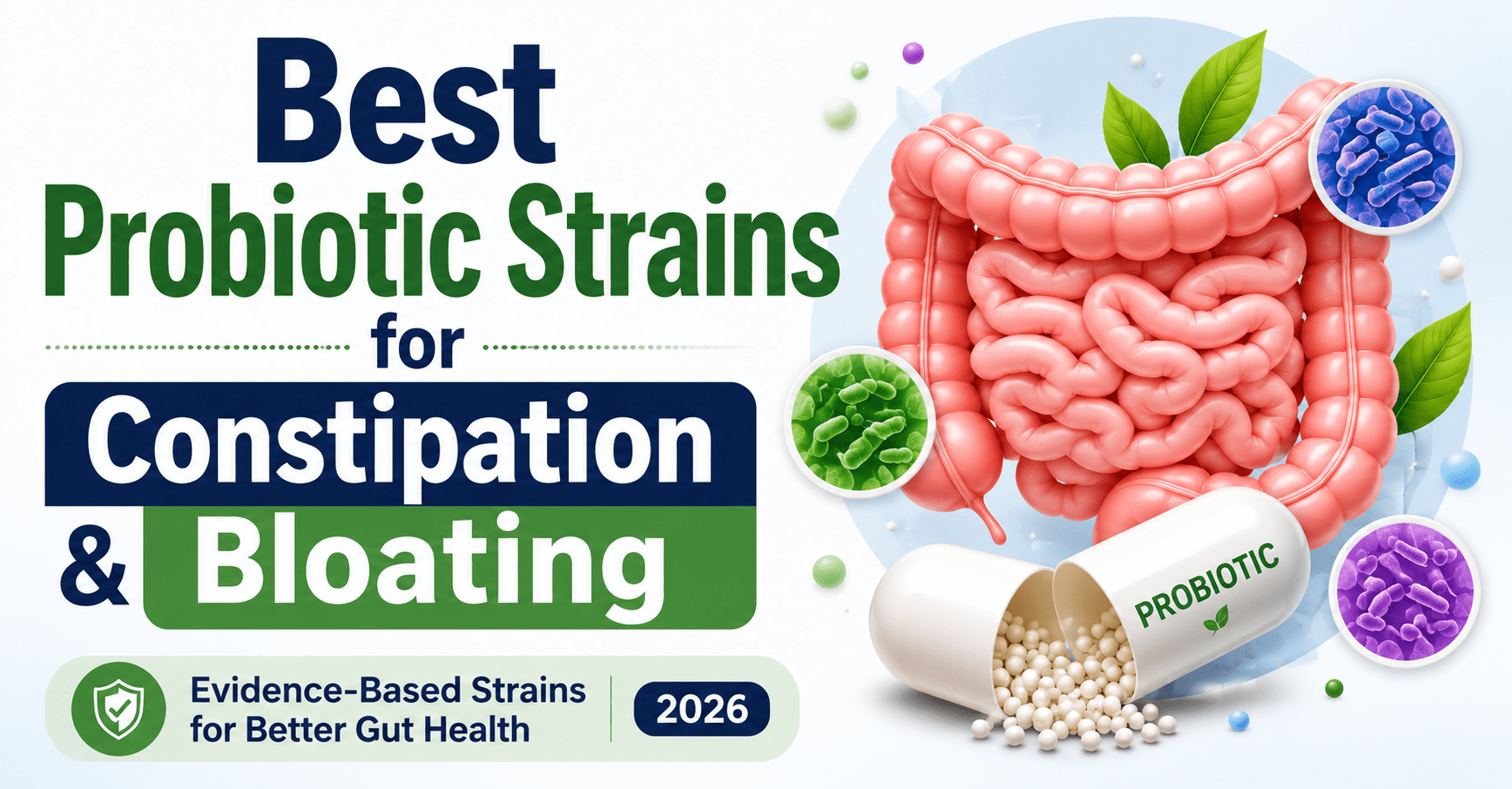
You’ve already tried a probiotic. Maybe it did nothing. Maybe the bloating got worse before it got better. Or maybe you bought one with “50 Billion CFU!” on the label, assuming bigger meant better — only to notice little or no change weeks later.
Here’s the problem: most probiotics for constipation and bloating are marketed by CFU count, not by clinical evidence. But the specific probiotic strain inside the capsule — the exact bacterial subtype — is what actually determines whether a probiotic may help gut motility, bowel regularity, gas, or IBS-related bloating.
In this guide, we break down the best probiotic strains for constipation and bloating based on published human clinical research, including which strains are most studied for stool frequency, gut transit time, bloating, and digestive comfort.
Quick Picks: Best Strain for Your Symptom
Not sure where to start? Find your primary symptom below.
| Symptom / Goal | Best Probiotic Strain | Why It Stands Out |
|---|---|---|
| 💊 Best for constipation | B. lactis BB-12 | Most consistent RCT data for stool frequency |
| 💨 Best for bloating | L. plantarum 299v | Multiple RCTs showing bloating reduction |
| 🔄 Best for both constipation + bloating | L. reuteri DSM 17938 | Supports gut motility and bloating together |
| 🪨 Best for hard stools | L. casei Shirota | May help soften stools; found in Yakult |
| 🧓 Best for older adults | B. longum BB536 | RCT data specifically in elderly constipation patients |

The One Thing That Matters: Strain Code, Not CFU Count
Before diving into individual strains, here is the single most important idea in this article:
The strain code on the label — not the CFU number — is what connects a product to clinical research. “Bifidobacterium lactis BB-12” and “Bifidobacterium lactis HN019” are two strains of the same species. They have been studied for different things. A product listing only “Bifidobacterium lactis” without a strain code cannot tell you which one is inside.
A 2014 meta-analysis in The American Journal of Clinical Nutrition found that probiotics reduced gut transit time by roughly 12 hours and increased weekly bowel movements — but the benefit was most pronounced for specific, identifiable strains. Generic “probiotic blends” often contain strains with no relevant human trial data at all.
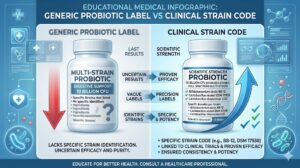
🔑 The Rule of Thumb When buying a probiotic for constipation or bloating, always look for a strain code on the label. If you see only the species name with no designation (e.g., “BB-12,” “DSM 9843,” “DSM 17938”), the product cannot be linked to the specific clinical evidence described in this article.
How Probiotics Work (The Short Version)
Different strains use different mechanisms — which is why each one tends to help a different symptom:
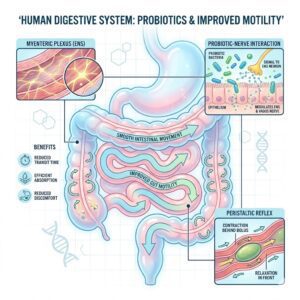
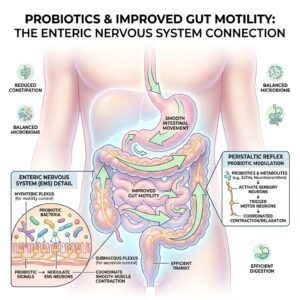
- Gut motility support: L. reuteri may influence the enteric nervous system, supporting colonic muscle contractions. See: L. reuteri for constipation and bloating.
- SCFA production: Bifidobacterium species ferment dietary fiber into compounds (butyrate, acetate) that acidify the colon and support motility.
- Gas regulation: L. plantarum may help regulate fermentation patterns, reducing gas volume and bloating.
- Stool softening: L. casei Shirota may influence gut metabolites that retain moisture in stool.
Two other terms worth knowing: probiotics are live bacteria; prebiotics are fibers that feed them. Taken together (“synbiotics”), some research suggests better results than either alone. Our full probiotic review covers synbiotic formulas in detail.
Affiliate Disclosure: This article contains affiliate links (Amazon Associates and iHerb). We may earn a small commission if you purchase through them, at no extra cost to you. Our recommendations remain independent and unbiased.
The 5 Best Probiotic Strains for Constipation and Bloating
Strain #1
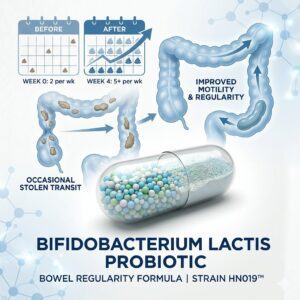
Bifidobacterium lactis
Strain codes: BB-12® and DN-173 010 · Also listed as B. animalis subsp. lactis on newer product labels
⚡ Bottom Line The most studied probiotic strain for constipation. Multiple RCTs show it increases stool frequency and reduces gut transit time. Best matched to: low stool frequency, hard or lumpy stools, sluggish digestion.
What the Research Shows
| Study | Key Finding |
|---|---|
| Eskesen et al., 2015 Br J Nutr · 1,248 adults · BB-12® · 4 weeks |
Defecation frequency was higher in the BB-12 group in each study week (P=0.0065). In a stricter responder analysis, BB-12 significantly outperformed placebo (P=0.0003). Note: the primary global well-being endpoint did not reach statistical significance (P=0.071). |
| Dimidi et al., 2014 Meta-analysis · Am J Clin Nutr |
Stool frequency increased by 1.5 bowel movements per week and stool consistency improved compared to placebo — among the largest pooled effects across all probiotic strains analyzed. |
| Marteau et al., 2002 DN-173 010 · Healthy women |
Colonic transit time was significantly reduced. This is the foundational study for DN-173 010’s motility effects, and is the source regularly cited in subsequent reviews. |
At a Glance
- Primary benefit:Constipation — stool frequency and transit time
- Dose range (clinical trials):1–10 billion CFU/day
- Time to effect:2–4 weeks
- Best for:Chronically low stool frequency, slow gut transit
Products Containing This Strain
Strain #2
Lactobacillus plantarum 299v
Strain code: DSM 9843 · Trademarked: LP299V™ · Also listed as Lactiplantibacillus plantarum on newer labels
⚡ Bottom Line The strongest strain-specific evidence for bloating and gas. Several RCTs show significant reductions in abdominal distension and discomfort. Most studies were in IBS patients — results may vary in non-IBS individuals.
What the Research Shows
| Study | Key Finding |
|---|---|
| Ducrotté et al., 2012 World J Gastroenterol · 214 IBS patients · 4 weeks · 10B CFU/day |
Abdominal pain frequency fell 51.9% in the LP299V group vs. 11.3% in placebo. Bloating and incomplete evacuation were also significantly reduced (P<0.05). |
| Niedzielin et al., 2001 40 IBS patients · double-blind RCT |
10/20 patients in the LP299V group achieved complete relief from abdominal pain vs. 1/20 in placebo (P=0.0012). A trend toward improved stool frequency was observed in constipation-dominant patients. |
At a Glance
- Primary benefit:Bloating, gas, abdominal pain
- Dose range (clinical trials):10 billion CFU/day
- Time to effect:2–3 weeks
- Best for:Abdominal bloating as the main complaint; IBS-C with bloating
Products Containing This Strain
Strain #3
Lactobacillus reuteri
Primary strain codes: DSM 17938 and ATCC PTA 6475 · Also listed as Limosilactobacillus reuteri on newer labels
⚡ Bottom Lineb One of the few strains with direct evidence for gut motility — meaning it may help move stool through the colon more effectively. Also studied for bloating. Good option when constipation and bloating occur together.
What the Research Shows
| Study | Key Finding |
|---|---|
| Ojetti et al., 2014 J Gastrointestin Liver Dis · DSM 17938 · 100M CFU/day · 4 weeks · Constipated adults |
Weekly bowel movements increased by 2.6 per week vs. baseline. Abdominal discomfort and bloating decreased significantly relative to placebo. |
At a Glance
- Primary benefit:Gut motility — supports stool movement through the colon
- Secondary benefit:Constipation-related bloating and abdominal discomfort
- Dose range (clinical trials):100–200 million CFU/day (lower than most strains)
- Time to effect:4 weeks
- Best for:Slow transit constipation; constipation with bloating together
Products Containing This Strain
Strain #4
Bifidobacterium longum
Primary strain code: BB536 · Also studied: W11
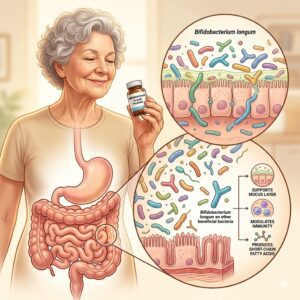
⚡ Bottom Line One of the most naturally abundant bacteria in a healthy gut — and one of the first to decline with age. The BB536 strain has a dedicated RCT in elderly constipation patients, making it a targeted choice for older adults.
What the Research Shows
| Study | Key Finding |
|---|---|
| Takeda et al., 2023 Am J Gastroenterol · BB536 · 50B CFU/day · 4 weeks · 80 older adults (RCT) |
Significant within-group improvement in the BB536 arm on constipation scoring. Stool frequency subscale: P=0.008. The primary endpoint did not show a statistically significant intergroup difference, but the within-group improvements were clinically meaningful. |
| Multiple dairy RCTs (Xiao et al., 2020 review) BB536 in dairy products |
Consistently improved defecation frequency and stool consistency across multiple controlled studies. |
At a Glance
- Primary benefit: Constipation — stool frequency and stool quality
- Dose range (clinical trials): 1–50 billion CFU/day
- Time to effect: 4 weeks
- Best for: Older adults with constipation; declining gut microbiome diversity
Products Containing This Strain
Strain #5
Lactobacillus casei Shirota
Found in: Yakult · Abbreviation: LcS · Also listed as Lacticaseibacillus paracasei strain Shirota on newer labels
⚡ Bottom LineThe simplest food-based option for hard, difficult-to-pass stools. LcS shows consistent clinical evidence for stool softening — though meta-analysis evidence for stool frequency is weaker than for B. lactis. Best matched to painful, hard stools rather than infrequent ones.
What the Research Shows
| Study | Key Finding |
|---|---|
| Ou et al., 2019 Front Microbiol · 16 constipated patients · 100 mL/day · 28 days |
Defecation frequency increased from 4.8 to 7.8 times/week (P<0.05). Bristol Stool Scale improved from 2.5 to 3.7 (P<0.05), indicating significantly softer stools. |
| Dimidi et al., 2014 meta-analysis | Stool consistency improved significantly. However, stool frequency did not reach statistical significance in the pooled analysis — a key limitation of LcS compared to B. lactis. |
| Krammer et al., 2011 Slow-transit constipation RCT |
Colonic transit time improved in patients with transit time above 72 hours. |
At a Glance
- Primary benefit: Stool softening — particularly effective for Bristol type 1–2 stools
- Dose range (clinical trials): 6.5–10 billion CFU/day
- Time to effect: 2–4 weeks
- Limitation: Meta-analysis evidence for stool frequency is weaker than B. lactis. Use this strain when stools are hard and painful, not simply infrequent.
- Best for: Hard, painful stools; individuals who prefer a food-based approach
🥛 Simplest Option: Yakult Each bottle contains approximately 6.5–8 billion CFU of L. casei Shirota — the same strain studied in clinical trials. Available in most grocery stores. No capsule, no subscription required.
Products Containing This Strain

Side-by-Side: Which Strain Fits Your Symptoms?
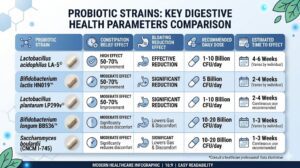
| Strain | Best For | Evidence | Clinical Dose | Time to Effect |
|---|---|---|---|---|
| B. lactis BB-12 / DN-173 010 | Constipation (frequency + transit) | Multiple RCTs | 1–10B CFU | 2–4 weeks |
| L. plantarum 299v (DSM 9843) | Bloating, gas, abdominal pain | Multiple RCTs (IBS) | 10B CFU | 2–3 weeks |
| L. reuteri DSM 17938 | Gut motility + constipation + bloating | Moderate–Strong | 100–200M CFU | 4 weeks |
| B. longum BB536 | Constipation (esp. older adults) | Moderate–Strong | 1–50B CFU | 4 weeks |
| L. casei Shirota (LcS) | Hard stools, stool softening | Moderate | 6.5–10B CFU | 2–4 weeks |
How to Choose the Right Strain
Match your primary symptom to the strain below:
- Infrequent bowel movements → B. lactis BB-12 or DN-173 010 · Most consistent RCT data for stool frequency · 1–10B CFU/day
- Abdominal bloating and gas → L. plantarum 299v (DSM 9843) · 10B CFU/day · Note: most evidence is in IBS populations
- Both constipation and bloating → L. reuteri DSM 17938 · Works on motility and bloating simultaneously · 100–200M CFU/day
- Hard, painful stools → L. casei Shirota · Yakult is the simplest delivery method · 6.5–10B CFU/day
- Older adult with constipation → B. longum BB536 · Specific RCT data in elderly patients · 1–50B CFU/day
What to Look for on a Probiotic Label
- Strain code, not just species: “Bifidobacterium lactis BB-12” is specific and verifiable. “Bifidobacterium lactis” alone is not. See our full product review for label-verified picks.
- CFU at expiration: Look for “CFU guaranteed through expiration” — not just at manufacture date.
- Storage requirements: Follow label instructions. Some strains require refrigeration to maintain viability.
- Third-party certification: USP, NSF, or Informed Sport certification verifies that the label matches what’s in the capsule.
Food-Based Alternatives
Some clinically studied strains are available through fermented foods:
- Yakult — L. casei Shirota · ~6.5–8B CFU per bottle · Grocery stores
- Activia yogurt — B. lactis DN-173 010 · Daily consumption studied in constipation trials
- Kefir — Multiple Lactobacillus and Bifidobacterium strains, but specific strain codes are typically not disclosed
- Fermented vegetables (kimchi, sauerkraut) — contain L. plantarum strains, though not necessarily the 299v designation
Food sources are convenient but achieving a consistent therapeutic dose is harder to verify than with supplements. For moderate to severe constipation, capsule-based supplements offer more reliable dosing. If you also take a fiber supplement, combining it with a probiotic may offer synbiotic-style benefits.
Side Effects and Precautions
Most people tolerate probiotics well. During the first 1–2 weeks, some experience temporary gas or altered bowel habits as the gut microbiome adjusts. This typically resolves on its own.
⚠️ Special Precautions: Individuals with serious immune conditions, short bowel syndrome, or a central venous catheter should consult a physician before starting any probiotic supplement. If you are taking antibiotics, take the probiotic at least 2 hours after each antibiotic dose.
Pregnant women and children should consult a physician before starting a probiotic. BB-12, L. reuteri DSM 17938, and LcS have all been studied in these populations, but dosing and safety guidance differs from adult use.
When to See a Doctor
See a doctor if you experience any of the following, as they may indicate an underlying condition that needs evaluation:
- Blood in the stool or black, tarry stools
- Sudden unexplained change in bowel habits (especially if over 40)
- Unexplained weight loss
- Severe or persistent abdominal pain
- No improvement after 2–3 months of consistent probiotic use — in this case, consider whether an underlying cause needs addressing first
Frequently Asked Questions
Which probiotic strain is best for constipation?
Bifidobacterium lactis BB-12 or DN-173 010 has the most consistent clinical evidence for increasing stool frequency and reducing gut transit time in adults with constipation.
Which probiotic strain is best for bloating?
Lactobacillus plantarum 299v (DSM 9843) showed significant bloating reduction in a 4-week RCT of 214 IBS patients. Most evidence for this strain comes from IBS populations, so results in non-IBS individuals may vary.
How long do probiotics take to work for constipation?
Most clinical trials show improvements within 2–4 weeks of daily use. Some people respond earlier; others need 6–8 weeks. Consistency matters — take your probiotic at the same time each day.
Can I take multiple probiotic strains together?
Yes. Multi-strain formulas are common in clinical research. Combining B. lactis and L. plantarum could provide support for both constipation and bloating simultaneously. Always confirm that strain codes are listed on the label.
What CFU count should I look for?
Effective clinical doses range from 100 million (L. reuteri) to 50 billion CFU (B. longum BB536). Strain identity matters more than CFU count — a high number does not compensate for an unstudied strain.
Do probiotics help with both IBS and constipation?
Some strains — particularly L. plantarum 299v and L. reuteri DSM 17938 — have been studied in both IBS-C and functional constipation populations. Evidence for IBS-related bloating and pain is generally stronger than for isolated functional constipation.
📋 Educational Disclaimer
- Eskesen D, et al. Effect of the probiotic strain Bifidobacterium animalis subsp. lactis, BB-12®, on defecation frequency in healthy subjects with low defecation frequency. Br J Nutr. 2015;114(10):1638–46. DOI: 10.1017/S0007114515003347. PMC4657032
Editorial note: Primary endpoint P=0.071 (not significant); defecation frequency P=0.0065; stricter responder analysis P=0.0003.
- Dimidi E, et al. The effect of probiotics on functional constipation in adults: a systematic review and meta-analysis. Am J Clin Nutr. 2014;100(4):1075–84. PMID: 25099542
- Marteau P, et al. Bifidobacterium animalis strain DN-173 010 shortens colonic transit time in healthy women. Aliment Pharmacol Ther. 2002;16(3):587–593. DOI: 10.1046/j.1365-2036.2002.01188.x
Editorial note: Primary source for DN-173 010 transit time data; not Ou et al. 2019, which was a secondary citation.
- Ducrotté P, Sawant P, Jayanthi V. Clinical trial: Lactobacillus plantarum 299v (DSM 9843) improves symptoms of irritable bowel syndrome. World J Gastroenterol. 2012;18(30):4012–18. PMC3419998
- Niedzielin K, Kordecki H, Birkenfeld B. A controlled, double-blind, randomized study on the efficacy of Lactobacillus plantarum 299V in patients with irritable bowel syndrome. Eur J Gastroenterol Hepatol. 2001;13(10):1143–7. PMID: 11711768
- Nobaek S, et al. Alteration of intestinal microflora is associated with reduction in abdominal bloating and pain in patients with irritable bowel syndrome. Am J Gastroenterol. 2000;95(5):1231–8. PMID: 10811330
- Ojetti V, et al. The effect of Lactobacillus reuteri supplementation in adults with chronic functional constipation. J Gastrointestin Liver Dis. 2014;23(4):387–91. PMID: 25537581
- Takeda T, et al. Usefulness of Bifidobacterium longum BB536 in Elderly Individuals With Chronic Constipation: A Randomized Controlled Trial. Am J Gastroenterol. 2023. DOI: 10.14309/ajg.0000000000002028. PMC9973440
Editorial note: Lead author is Takeda (not “Naito”). Journal is Am J Gastroenterol (not J Gastroenterol).
- Xiao JZ, et al. Beneficial effects of Bifidobacterium longum BB536 on human health. J Funct Foods. 2020;64:103655. DOI: 10.1016/j.jff.2019.103655
- Petrella E, et al. The Anti-Constipation Effect of Bifidobacterium longum W11 Is Likely Due to a Key Genetic Factor Governing Arabinan Utilization. Microorganisms. 2024;12(8):1626. PMC11356487
- Ou Y, et al. Lactobacillus casei Strain Shirota Alleviates Constipation in Adults by Increasing the Pipecolinic Acid Level in the Gut. Front Microbiol. 2019;10:324. PMC6394200
- Koebnick C, et al. Probiotic beverage containing Lactobacillus casei Shirota improves gastrointestinal symptoms in patients with chronic constipation. Can J Gastroenterol. 2003;17(11):655–9. PMID: 14631461
- Krammer HJ, et al. Effect of Lactobacillus casei Shirota on colonic transit time in patients with chronic constipation. Coloproctology. 2011. DOI: 10.1007/s00053-011-0177-0






[…] To see how different probiotic strains compare for constipation, read our probiotic strain comparison for constipation and bloating (2026). […]
[…] food sources: Yogurt (with live Bifidobacterium and Lactobacillus cultures), kefir, and […]
[…] Best Probiotic Strains for Constipation and Bloating — if you want to compare strains directly […]
[…] Here’s the real pattern across this research: outcomes depend on the specific strain and dose used, not on whether the product is called a “probiotic” or “synbiotic.” A 2022 systematic review pooling 30 randomized trials found that Bifidobacterium lactis reliably increased stool frequency, while probiotic mixtures and other individual strains did not show the same effect (DOI: 10.1016/j.clnu.2022.10.015). Two products can both say “probiotic for constipation” on the label and have very different evidence behind them, depending only on which strain is inside. For a deeper look, see our guide to the best probiotic strains for constipation and bloating. […]
[…] The gut microbiome itself shifts in step with these hormonal changes. After menopause, a woman’s gut microbial profile tends to shift toward a composition that more closely resembles the male microbiome — researchers describe this as a loss of the female-specific microbial diversity that estrogen previously helped maintain. For a closer look at this transition specifically, see constipation and bloating: what’s actually happening. […]
[…] For a head-to-head strain comparison focused specifically on bloating alongside constipation, see Best Probiotic Strains for Constipation and Bloating. […]
[…] look at which strains have the most evidence, see our guide on probiotics and chronic constipation,Probiotic Strains,Probiotics Help Constipation? and our best probiotic supplements roundup for specific product […]
[…] gut, IBS, SIBO, chronic […]
[…] That makes it a biologically plausible option for supporting regularity, but the effect is strain-specific and it is not a proven treatment for constipation itself. For the research-backed basics, see our guide to the best probiotic strains for constipation and bloating. […]
[…] makes the results hard to compare [7]. To see how individual strains stack up, our guide to the best probiotic strains for constipation and bloating goes through them one by […]